Research

Deployment science in clinical AI

Many clinical prediction models perform well in the data used to develop them and are never used in patient care. The lab studies what it takes for a model to become a tool that clinicians can use safely and health services can oversee: validation in new settings, integration into clinical workflows, and governance once in use. The work spans dermatology, pathology, ophthalmology and health systems.

Framework

Four stages of clinical AI

01

Build

Does the model address a defined clinical decision?

Models are developed from clinical data for a specific decision, with the intended users and setting defined at the outset.

02

Validate

Does performance hold in new patients and settings?

Peer review, testing in external cohorts, and reporting of calibration and uncertainty. Strong results from small cohorts are treated as preliminary.

03

Deploy

Can it be used safely in routine care?

Integration into clinical workflows, with interpretable outputs and defined clinical and data governance.

04

Govern

Does it remain safe over time?

Post-deployment monitoring, accountability, and the ethics review that determines whether a tool should be used at all.

Each tool on this site is placed at the furthest stage its public evidence supports. See the tools page.

Research questions

9 current research questions

Where work is in progress, entries describe the question and approach. Results are reported here once they are published.

Dermatology

Can objective skin measurements improve melanoma risk prediction?

Funded · Viertel Clinical Investigator Award
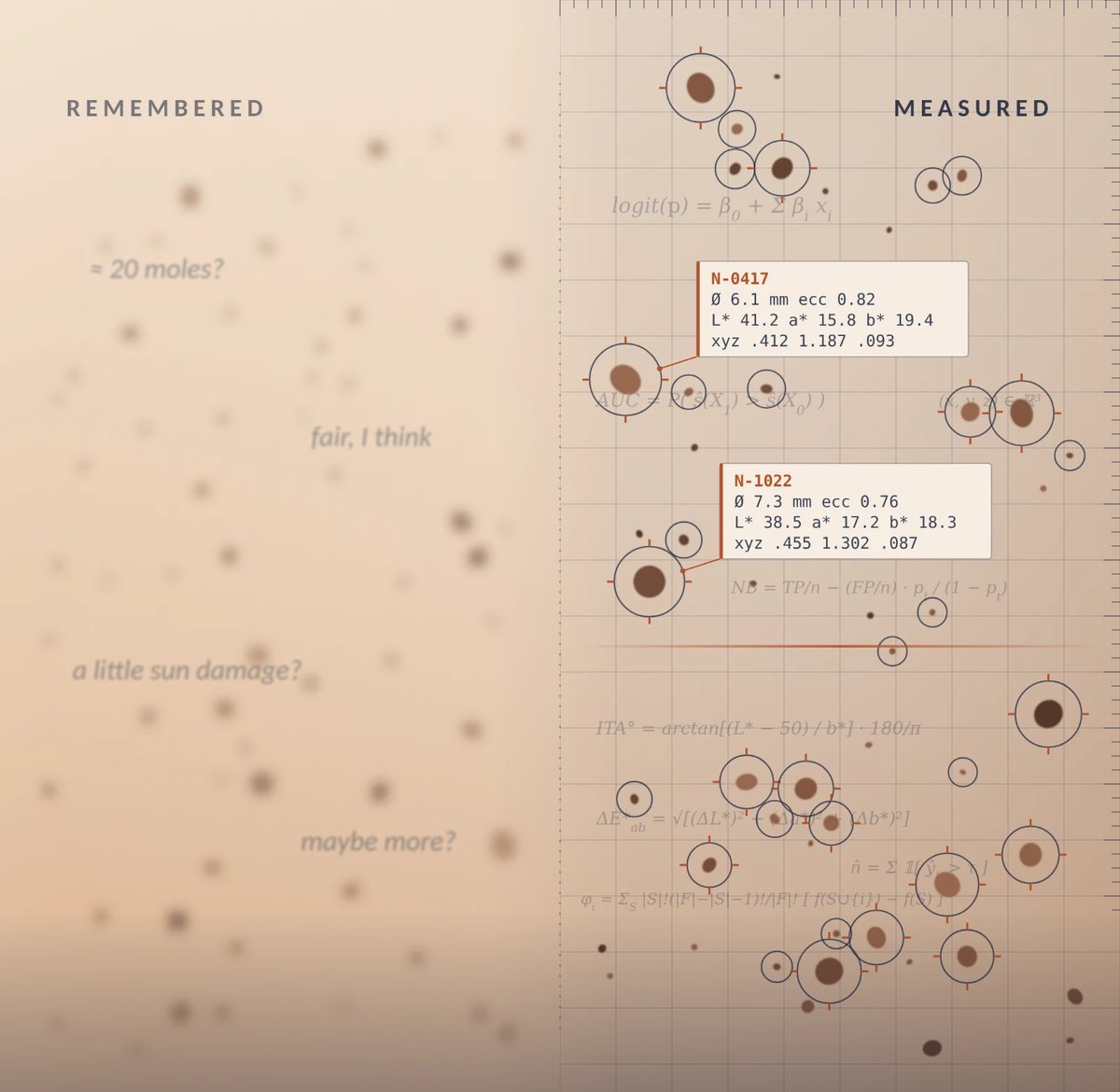
Illustration: blurred, self-reported moles on the left; the same skin measured with sized, catalogued lesions and model equations on the right.
Melanoma risk: replacing what patients recall about their skin with what 3D total-body photography measures.

BackgroundAustralian melanoma risk models rely on self-reported traits such as mole counts, freckling, sun damage and skin colour. In external validation their accuracy is modest, and adding polygenic risk scores has improved it only slightly.

ApproachThe study measures the same traits objectively from 3D total-body photography and tests whether this improves calibration and clinical net benefit. If it does not, the limit is more likely to be biological than a problem of measurement, which would direct future work toward molecular, environmental and longitudinal predictors.

  • 3D total-body photography
  • Prospective national cohort
  • Nested model comparison
  • Calibration and net benefit
With Prof Anne Cust’s team at the Daffodil Centre, within the ACEMID cohort and the AUTOMATE ME trial
Dermatology

Which groups in NSW are diagnosed with melanoma at a later stage?

Protocol complete · data access underway

BackgroundStage and thickness at diagnosis are the main determinants of melanoma outcome. Less is known about how they vary by country of birth, language, remoteness and income across a whole population.

ApproachThe study links more than 120,000 NSW melanoma diagnoses since 1994 with Census, Medicare, pharmaceutical, hospital and death records. It describes variation in stage at diagnosis and distinguishes model error that recalibration can address from inequities that require changes to services or policy.

  • Population data linkage
  • Multilevel and survival models
  • Stage, thickness and subtype
  • ABS secure environment
With Prof Anne Cust and the Daffodil Centre
Dermatology

How should melanoma screening thresholds reflect regional workforce?

Public prototype
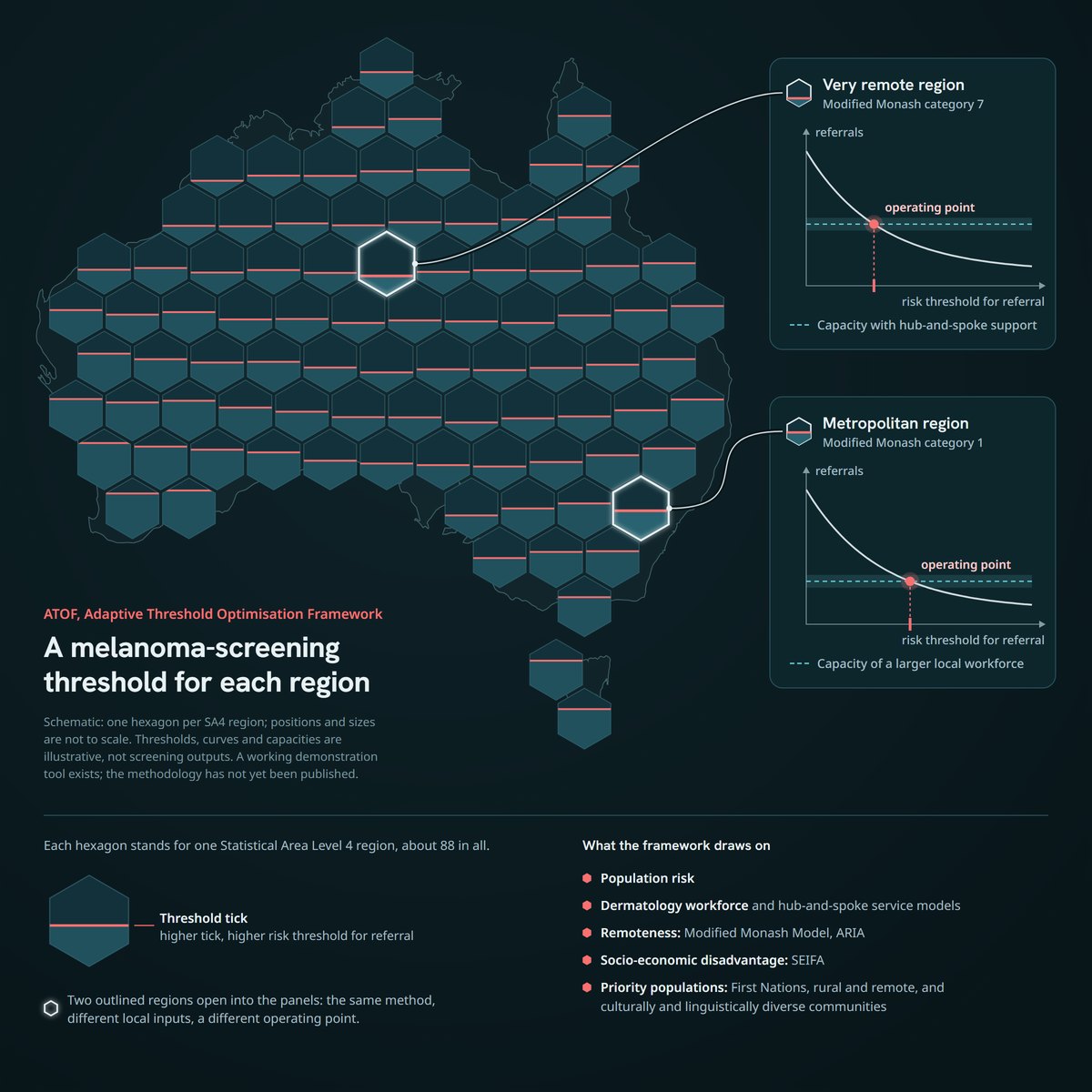
A hexagonal map of Australia with about 88 hexagons, one per Statistical Area Level 4 region, each carrying a threshold tick. A very remote and a metropolitan hexagon open into panels where the referral curve meets a different capacity line, giving each region its own operating point.
ATOF: a melanoma-screening threshold for each region, weighing population risk against the dermatology workforce and equity considerations. Illustration; the hexagonal map is schematic, and thresholds and curves are illustrative, not screening outputs.

BackgroundA single national threshold for risk-based screening does not account for regional differences in the dermatology workforce, and more intensive screening carries a risk of overdiagnosis.

ApproachHow screening eligibility can be set from an explicit weighting of benefits and harms, including overdiagnosis, and then adapted to the workforce available in each region.

  • Decision-curve analysis
  • Overdiagnosis and lead-time bias
  • Workforce-aware planning
Ophthalmology

How much ultraviolet radiation reaches the eye, and where?

Screening complete · manuscripts in preparation

BackgroundThe UV Index describes ambient radiation rather than exposure at the eye. The cornea absorbs most UVB, the lens transmits more ultraviolet light in childhood than in later life, and facial anatomy and gaze direction concentrate light on particular regions of the eye.

ApproachWhether sun damage to the periocular skin corresponds to ultraviolet damage in the eye, how much exposure hats and sunglasses prevent in practice, and what the optics of the eye imply for eye diseases that have been linked to sunlight.

  • Ocular UV autofluorescence
  • Periocular skin imaging
  • Mannequin UV dosimetry
  • Integrated literature review
With Prof Ewa Goldys, Dr Shanel Sharma, Dr Daya Sharma, Dr Rasha Cosman, A/Prof Svetlana Cherepanoff and Prof Anthony Joshua
Ophthalmology

Can blood biomarkers classify macular degeneration by mechanism?

Collaboration · ethics under review

BackgroundDry age-related macular degeneration is now the leading cause of vision loss in the disease and remains largely untreatable. Blood markers of mitochondrial stress have been reported, mainly in the neovascular form.

ApproachThe study aims to replicate a published blood signature of mitochondrial stress, extend it to dry AMD, and combine proteomics, lipidomics and genetics in the same individuals to classify patients by disease mechanism.

  • Acylcarnitine assays
  • Aptamer proteomics
  • Lipidomics
  • Genotype and proteome
With A/Prof Gerald Liew’s retinal research group, Westmead Institute for Medical Research
Ophthalmology

What is normal eye growth in Australian children?

Live demonstrator · ethics pending
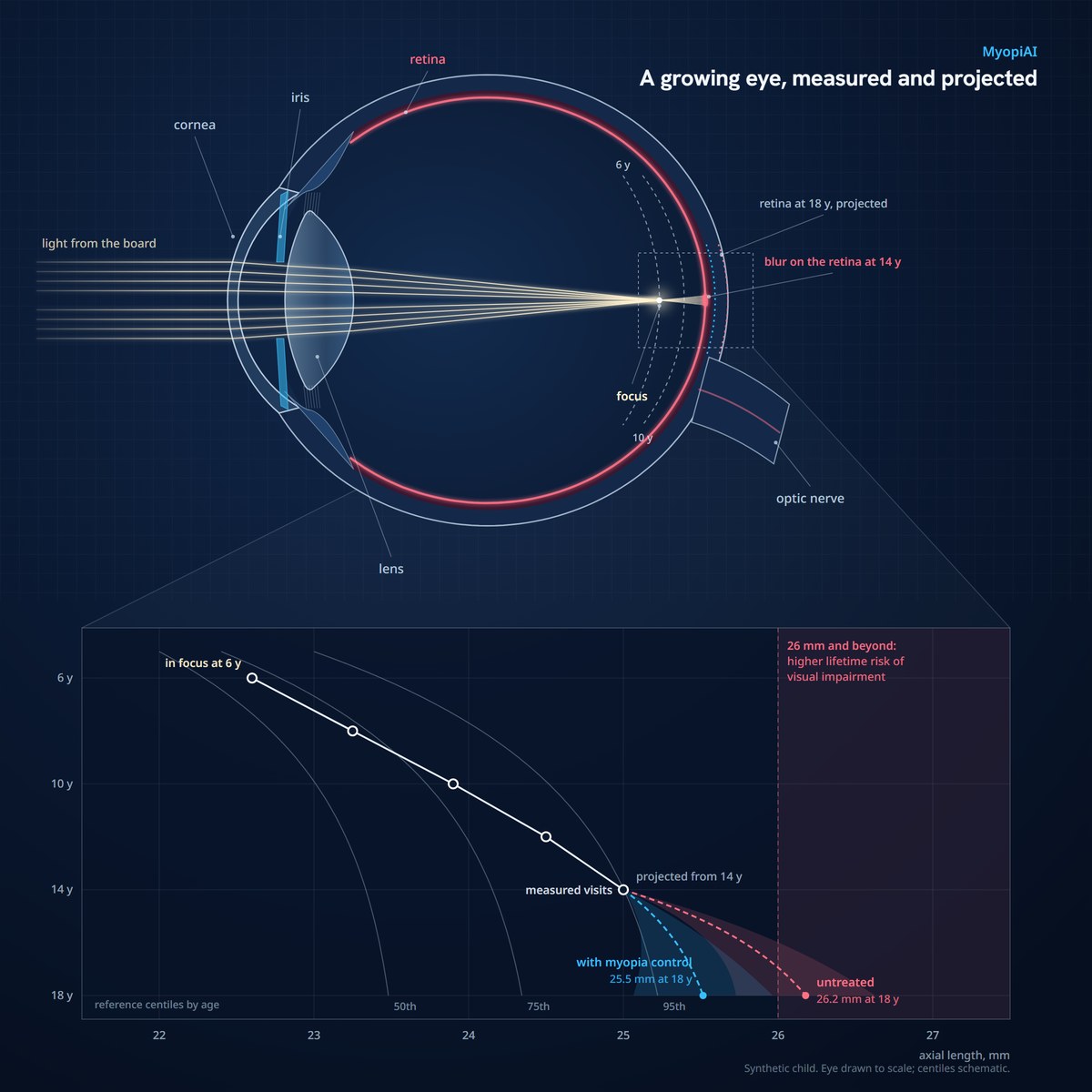
Illustration: a cross-section of a child’s eye drawn to scale, with light from a distance coming to focus in front of the retina as the eye lengthens; below, the child’s axial length plotted against age centiles and projected to age 18 with and without myopia control.
Myopia: as a child’s eye lengthens, distant light comes to focus in front of the retina. Measured axial length is tracked against age centiles and projected forward with and without myopia control. Illustration; the child is synthetic.

BackgroundDecisions about myopia control increasingly depend on the rate of axial elongation, but the growth references in common use are derived largely from European cohorts.

ApproachDevelopment of Australian growth centiles for axial length by age, sex and ancestry, to assess treatment response in individual children, with an uncertainty range reported for each prediction.

  • Axial-length biometry
  • Mixed-effects trajectories
  • Conformal uncertainty
  • Fairness by ancestry
With A/Prof Daniel Hesselson and Dr Loreto Rose
Pathology & oncology

Can routinely reported pathology improve cancer prognosis?

Three peer-reviewed models
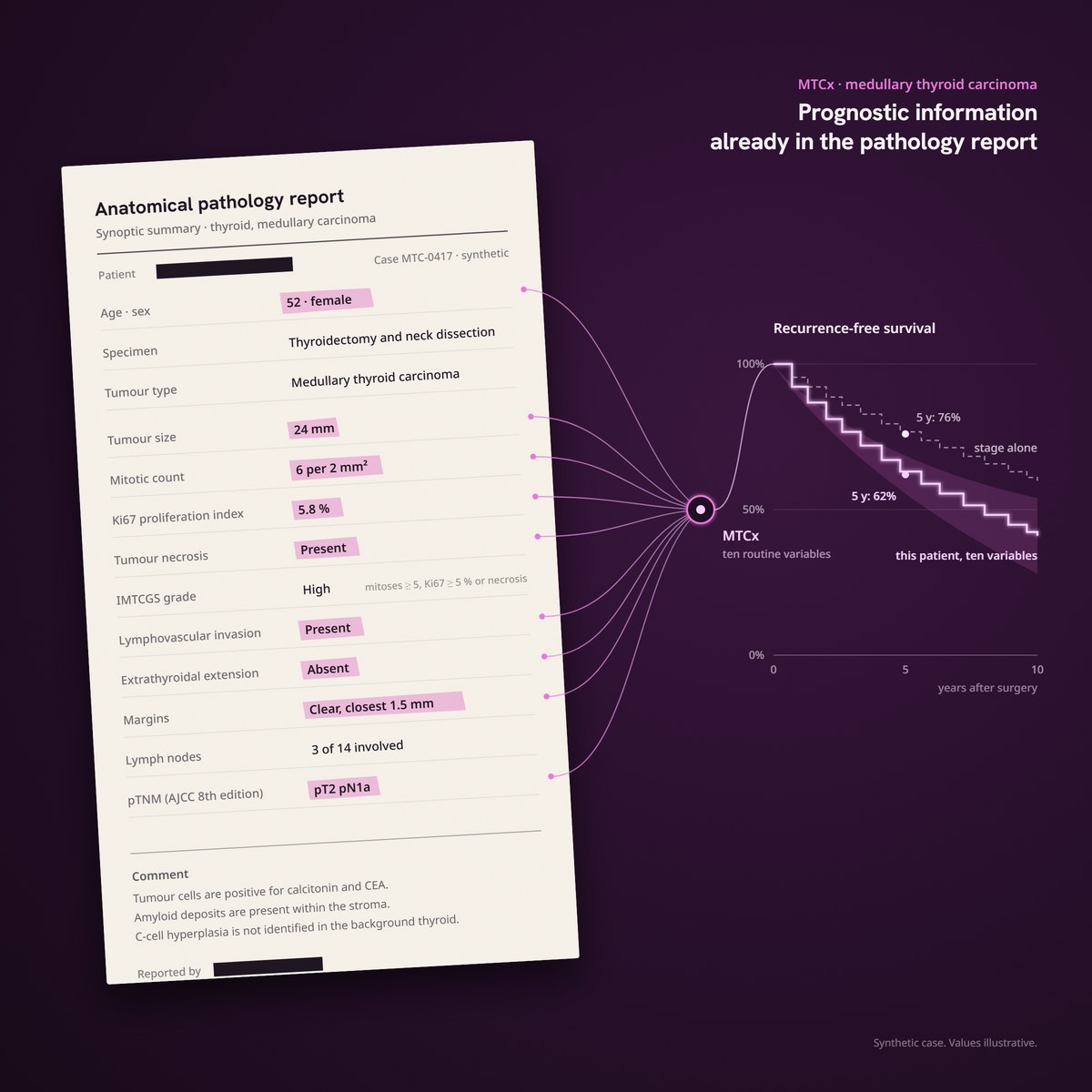
Illustration: a synoptic pathology report for medullary thyroid carcinoma with ten routine fields highlighted, each linked by a thread to one recurrence-free survival curve, shown against a curve based on stage alone.
Medullary thyroid carcinoma: ten variables already recorded in a routine pathology report combine into one patient’s estimate of recurrence-free survival, shown against an estimate from stage alone. Illustration; the case is synthetic.

BackgroundPathology reports contain prognostic information, including tumour grade, necrosis, depth of invasion and immunohistochemistry, much of which is not used in staging-based prognosis.

ApproachPrognostic models built from routinely reported pathology features, with interpretable outputs, and tested in patients from other centres. Published models cover mesothelioma, medullary thyroid carcinoma and malignant colorectal polyps.

  • Histological grading
  • Immunohistochemistry
  • Survival modelling
  • External validation
With Prof Anthony J. Gill and the Cancer Diagnosis and Pathology Group, Kolling Institute
Health systems

How should clinical AI report uncertainty?

Applied across the lab’s tools

BackgroundMost clinical prediction studies report discrimination, such as the AUC. Fewer report calibration, and few models are monitored after they are introduced into care.

ApproachMethods for reporting calibration and uncertainty with individual predictions, including conformal and Venn-ABERS approaches, decision-curve analysis, fairness audits and monitoring for drift after deployment.

  • Calibration
  • Conformal prediction
  • Decision curves
  • Post-deployment drift
AI governance

How can ethics review of health AI research be made faster and more consistent?

NHMRC REP-AI, 2025–2028
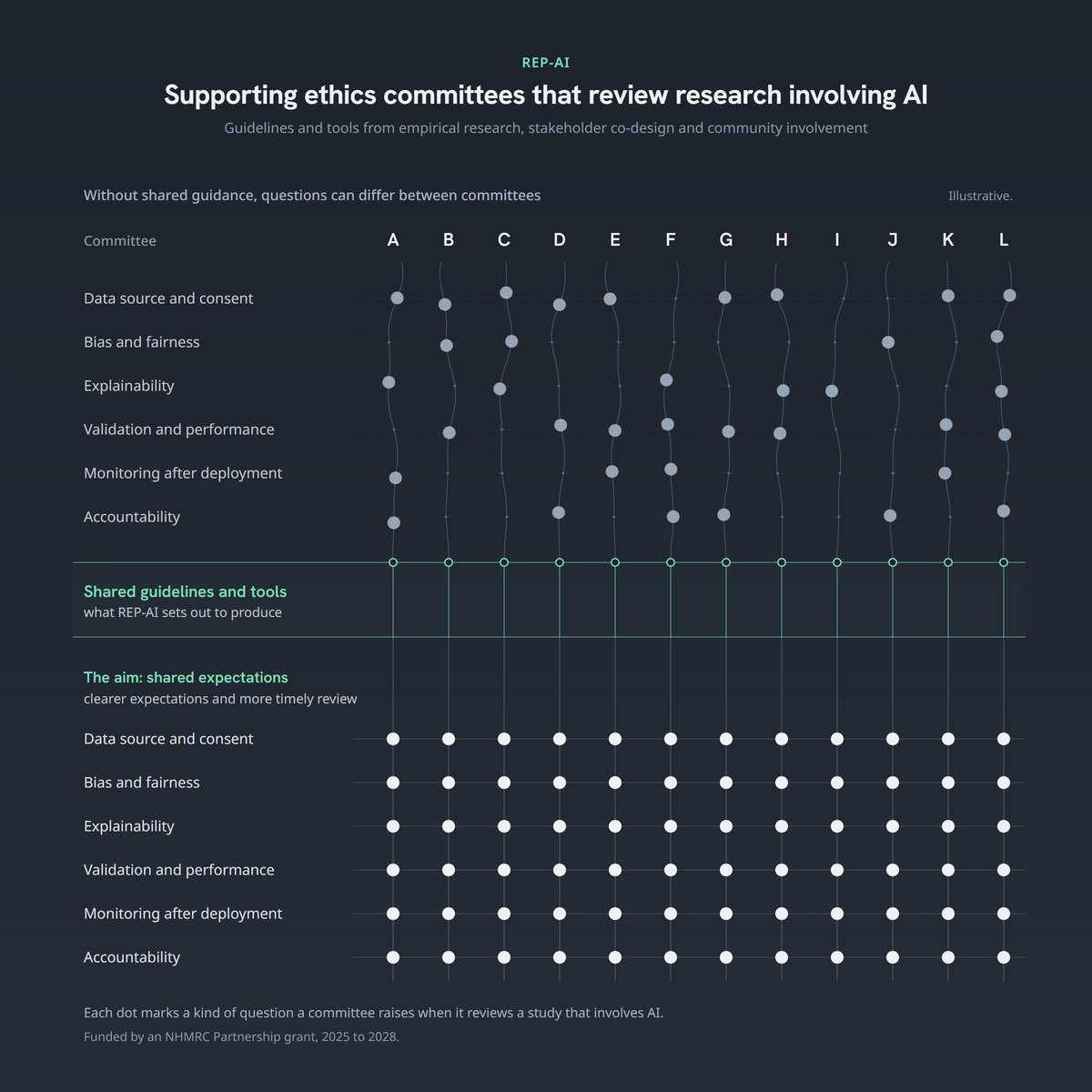
Two dot matrices of twelve committees against six kinds of question about AI research. Above, the dots are scattered; a band of shared guidelines and tools separates it from the matrix below, where every dot is aligned and labelled as the aim.
REP-AI: shared guidelines and tools for ethics committees that review research involving AI, with the aim of clearer expectations and more timely review. Illustration; the committees and pattern of questions are invented.

BackgroundEthics and governance approval is required for every clinical trial and AI study, and approval times vary between jurisdictions and institutions.

ApproachMeasurement of approval times across Australia before and after the COVID-19 pandemic, and development of a national framework to support ethics committees reviewing health AI research.

  • National cross-sectional study
  • Approval-time metrics
  • Health AI review framework
Melanoma program

Melanoma, from imaging to a prospective trial

The melanoma program covers objective measurement from 3D total-body photography, risk prediction, screening thresholds, linked population data, national screening policy and a prospective trial. It is conducted with Prof Anne Cust and the Daffodil Centre’s Melanoma and Skin Cancer group. Several components have not yet reported results.

  1. Image

    What can a 3D photograph of the whole skin measure objectively?

    3D photodamage modelPrototype

    A deep-learning model that grades sun damage from 3D total-body photography, one skin tile at a time, and aggregates the result into a patient-level severity score, visualised on a 3D “sun-damage avatar”.

  2. Risk

    Do those measurements predict melanoma better than a questionnaire?

    AI image markers for melanoma riskIn progress · no results yet

    Today’s melanoma risk models (MIA/Vuong, Olsen, QSkin, Cho, Quereux) rely on what people report about themselves (mole counts, sun damage, freckling, skin colour) and reach only modest accuracy when tested on new populations. This project replaces those self-reported inputs with objective measurements from 3D total-body photography, and tests whether this improves prediction, using a Super Learner ensemble, SHAP explanations, Venn-ABERS calibration and decision-curve analysis.

    Project lead · ACEMID AI Working Group
  3. Place

    Where should screening thresholds sit, given the workforce available in each region?

    ATOFFramework · demo

    The Adaptive Threshold Optimisation Framework is a named methodology, developed with Prof Anne Cust, for setting melanoma-screening thresholds region by region, weighing population risk against the available dermatology workforce and equity considerations.

    Co-developer (with Prof Anne Cust)
  4. Population

    Who is diagnosed late, and at what cost, across 30 years of linked records?

    CANDLE-PLIDAProtocol complete · pre-results

    Links the NSW Cancer Registry (more than 120,000 melanoma cases, 1994–2023) with Census, Medicare, hospital, pharmaceutical and death records inside the Australian Bureau of Statistics’ PLIDA secure environment, to study incidence, health-service use, equity and cost. Fifteen research questions across five clusters. Dr Aksoy leads four as first author: immigration cohorts, referral-pathway disparities, stage-based costing, and medication-associated risk.

    Project lead (analytical and technical)
  5. Policy

    What evidence should a national screening program be built on?

    National Targeted Skin Cancer Screening RoadmapContributing

    A Cancer Australia–funded national framework for targeted skin-cancer screening. Dr Aksoy contributes the AI and digital-health evidence (risk-prediction models, AI-assisted dermoscopy, teledermatology and 3D total-body photography) as part of Prof Anne Cust’s team at the Daffodil Centre.

    AI & digital-health evidence · Daffodil Centre team
  6. Trial

    Does AI-enhanced risk stratification hold up inside a prospective trial?

    AUTOMATE MEFunded · begins 2027

    AI-enhanced melanoma risk stratification for the AUTOMATE ME trial, funded by a Viertel Clinical Investigator Award. It will test the program’s risk models prospectively within a trial, rather than on retrospective data.

    Awardee · Viertel Clinical Investigator Award
Programs

Research programs

In progress · no results yet

AI image markers for melanoma risk

Today’s melanoma risk models (MIA/Vuong, Olsen, QSkin, Cho, Quereux) rely on what people report about themselves (mole counts, sun damage, freckling, skin colour) and reach only modest accuracy when tested on new populations.

This project replaces those self-reported inputs with objective measurements from 3D total-body photography, and tests whether this improves prediction, using a Super Learner ensemble, SHAP explanations, Venn-ABERS calibration and decision-curve analysis.

Data preparation is underway; there are no results yet. Senior investigator Prof Anne Cust; ACEMID AI Working Group chair A/Prof Victoria Mar.

Project lead · ACEMID AI Working Group · Dermatology
Contributing

National Targeted Skin Cancer Screening Roadmap

A Cancer Australia–funded national framework for targeted skin-cancer screening.

Dr Aksoy contributes the AI and digital-health evidence (risk-prediction models, AI-assisted dermoscopy, teledermatology and 3D total-body photography) as part of Prof Anne Cust’s team at the Daffodil Centre.

AI & digital-health evidence · Daffodil Centre team · Dermatology
Protocol complete · pre-results

CANDLE-PLIDA

Links the NSW Cancer Registry (more than 120,000 melanoma cases, 1994–2023) with Census, Medicare, hospital, pharmaceutical and death records inside the Australian Bureau of Statistics’ PLIDA secure environment, to study incidence, health-service use, equity and cost.

Fifteen research questions across five clusters. Dr Aksoy leads four as first author: immigration cohorts, referral-pathway disparities, stage-based costing, and medication-associated risk.

The protocol is complete (early 2026); governance and data access are underway, with analysis planned for 2026–27. There are no results yet.

Project lead (analytical and technical) · Dermatology
Funded · begins 2027

AUTOMATE ME

AI-enhanced melanoma risk stratification for the AUTOMATE ME trial, funded by a Viertel Clinical Investigator Award.

It will test the program’s risk models prospectively within a trial, rather than on retrospective data.

Awardee · Viertel Clinical Investigator Award · Dermatology
In progress

Privacy-preserving federated learning: a systematic review

A PRISMA systematic review of how privacy-preserving techniques (differential privacy, homomorphic encryption, secure multi-party computation, secure and Byzantine-robust aggregation) are implemented in clinical federated learning, and how privacy–utility trade-offs are reported.

It distinguishes implementations in clinical settings from simulation studies.

Lead · Health systems
Four manuscripts in preparation

UV damage to skin and eye in elite cricketers

A combined dermatology and ophthalmology screen of more than fifty elite cricketers (clinical photography of the skin around the eyes, UV autofluorescence of the ocular surface, and optical biometry), asking whether skin and eye accumulate UV damage together or independently, and how batting stance and sex change the pattern.

Four manuscripts are in preparation: UV markers on the ocular surface, photodamage of the skin around the eyes, whether one organ can stand in for the other when screening, and why athletes do or do not wear protective eyewear. Findings are held until publication; early work was presented as a poster at the Australasian College of Dermatologists Annual Scientific Meeting 2026.

With ophthalmologists Shanel Sharma and Daya Sharma, and dermatology colleagues.

Lead analyst · first author · Ophthalmology
Review complete · retrospective study in design

UV and choroidal melanoma

Three decades of studies have found positive, null and even inverse links between UV exposure and choroidal melanoma. This work integrates the evidence across epidemiology, how UV travels through the eye, where tumours arise, and their genomics, to ask what role, if any, remains plausible.

The next step is a retrospective study relating tumour location, markers of UV exposure and molecular profile, with AI-assisted analysis.

With medical oncologists Rasha Cosman and Anthony Joshua, pathologist Svetlana Cherepanoff, and ophthalmologists Daya Sharma and Shanel Sharma.

Lead · first author · Ophthalmology
Pilot protocol ready

UV-EYE: how much UV reaches the eye?

The UV index describes ambient radiation rather than exposure at the eye. Ocular exposure depends on facial anatomy, the sun’s elevation, reflection from surfaces, and what is worn. UV-EYE measures it directly: a mannequin pilot with electronic UV sensors and low-cost colour-change dots around the eye, under a standard cricket hat, across full days outdoors.

The pilot asks whether a measurable UV signal still reaches the periocular region under a hat, and whether low-cost UV indicator dots are sensitive enough to detect it, before any human study. A literature review is in preparation.

With Ewa Goldys (UNSW), Daya Sharma and Shanel Sharma.

Protocol lead · Ophthalmology
Ethics under review

Blood biomarkers for age-related macular degeneration

A multi-omics study of banked plasma from people with and without AMD: acylcarnitines, large-scale proteomics, lipidomics and genotyping, all on the same individuals.

It begins by independently replicating a 2020 finding of altered acylcarnitines in AMD and extending it to dry AMD; the longer aim is a blood-based way to stratify patients by disease mechanism.

With Gerald Liew and the retinal research group at the Westmead Institute for Medical Research.

Co-lead (with Gerald Liew) · Ophthalmology
Joining · data agreement in progress

RETFound global study: synthetic retinal images

RETFound is an open foundation model for retinal images, and most of the data behind models like it come from a few high-income countries. This global study trains latent-diffusion models to generate synthetic colour fundus photographs, to test whether augmenting training data this way improves generalisability and fairness.

The lab is contributing through the Westmead Institute for Medical Research, where Gerald Liew is site lead; the data-sharing agreement is being finalised. Study investigators include Pearse Keane, Carol Cheung and Tham Yih Chung.

Contributor · Ophthalmology
Manuscript in preparation

Migraine, reflux and dry eye: a narrative review

A narrative review of the trigeminovascular connection between migraine and dry eye disease, and of the emerging hypothesis that laryngopharyngeal reflux (acid and pepsin reaching the ocular surface) may contribute to both, alongside modern environmental risk factors.

Author · Ophthalmology
Feasibility

Blue Mountains Eye Study: data-linkage feasibility

Exploring whether the Blue Mountains Eye Study can be linked with national health data through the Australian Institute of Health and Welfare, to study how eye disease relates to later health outcomes. Feasibility stage, with Gerald Liew.

Contributor · Ophthalmology
Manuscript in preparation

The optics of the elite batting eye

Ocular biometry of professional cricketers (eye length, corneal shape and optical aberrations, alongside retinal screening), asking whether the eyes that reach elite level share an optical profile, and how acuity is maintained in longer eyes.

It connects to OptoKVA’s measures of sport-relevant vision, so that eye structure can be related to on-field visual performance. Findings are held until publication.

With ophthalmologists Shanel Sharma and Daya Sharma.

Lead analyst · first author · Ophthalmology
Concept

UV and age-related macular degeneration: a theory paper

A theory paper extending the lab’s work on how UV travels through the eye to age-related macular degeneration. At concept stage.

Co-lead (with Shanel Sharma) · Ophthalmology
Governance

Research governance experience

Before establishing the lab, Dr Aksoy spent six years in senior policy roles at the NSW Ministry of Health, leading the state’s research ethics, governance and clinical-trials portfolio.

This experience informs the lab’s treatment of governance as part of its research, and its role as a chief investigator on REP-AI, the NHMRC-funded national framework for the ethical review of health AI research.

60→20days
Average approval time for early-phase clinical trials, as secretary of the NSW Early Phase Clinical Trial Framework working group
60→85%
Research-approval performance across NSW Health, over three years
222 + 404
Ethics and site approvals supported during the COVID-19 response
15LHDs
Local health districts whose chief executives met with him quarterly on research performance
Disclosure

Spin-outs and conflicts of interest

Statement

Dr Aksoy is a founder or co-founder of three companies: EosGene Therapeutics (gene and drug delivery), PanaceAI (clinical AI) and Acuity Intelligence (ophthalmic AI). He holds equity in each.

Several tools on this site are hosted by or developed with these companies, and each tool record says so. Commercial products and consulting services are provided by the companies, not by the lab, and nothing on this site is an offer of clinical use.

His work on the governance of health AI, including as a chief investigator on the NHMRC REP-AI partnership, is conducted independently of these companies.

Stated September 2026 · reviewed each year