Clinical AI, from publication to practice

Many clinical prediction models are published and never used in patient care. The laboratory develops clinical AI tools and studies what follows publication: external validation, implementation and governance. Each plate shows one piece of that work.

List of plates

Plate 5 of 14Pathology & oncology
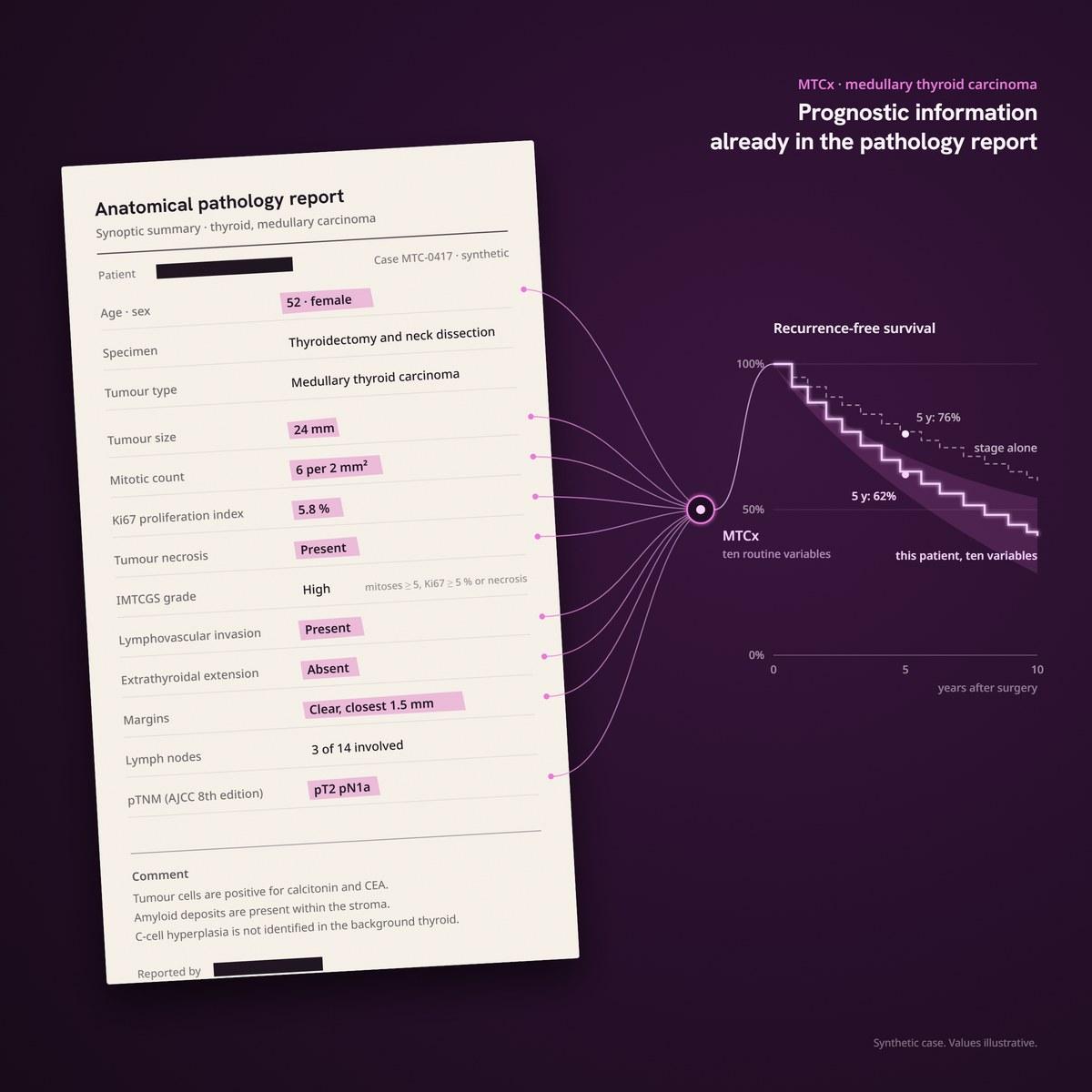
Illustration: a synoptic pathology report for medullary thyroid carcinoma with ten routine fields highlighted, each linked by a thread to one recurrence-free survival curve, shown against a curve based on stage alone.

MTCx recurrence prognosticator

Externally validated
Stage
Validated
Status
Peer-reviewed · externally validated · live calculators
Performance
AUC 0.94 · external AUC 0.90

Predicts recurrence-free survival in medullary thyroid carcinoma, a rare thyroid cancer. Published in Histopathology (2024).

Medullary thyroid carcinoma: ten variables already recorded in a routine pathology report combine into one patient’s estimate of recurrence-free survival, shown against an estimate from stage alone. Illustration; the case is synthetic.

MTCx, an international prognostic model

Medullary thyroid carcinoma is rare, so no single hospital sees enough patients to answer who will see their cancer return after surgery. The model was built across five centres and tested at a sixth.

Sydney 58New York 68Boston 40Paris 70Bologna 64Atlanta 87
Development centreExternal validationFigure 1. Development centres and the external validation site at Emory University. Figures beside each city are patients per centre.

After surgery for medullary thyroid carcinoma, which patients will see their cancer return? The cancer is rare, so no single hospital sees enough patients to answer this reliably. Prognosis has relied largely on stage.

Patients treated in Sydney, New York, Boston, Paris and Bologna. Tumours were graded with the International Medullary Thyroid Carcinoma Grading System, so pathology was comparable across centres.

300patients, five centres, four countries
0.94AUC in development
87patients at Emory University
0.90AUC in external validation

Mitotic count, Ki67, necrosis, lymphovascular invasion, extrathyroidal extension and margin status, with age, sex, stage and tumour size. MTCx estimates recurrence-free survival for an individual patient from the same routine variables.

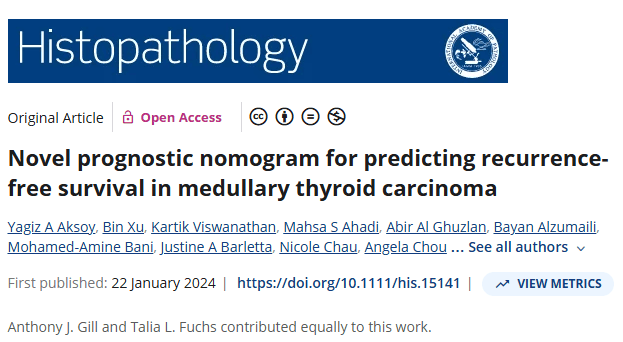
Histopathology, open access: Novel prognostic nomogram for predicting recurrence-free survival in medullary thyroid carcinoma. Aksoy YA et al., 2024.Histopathology, 2024, open access

Index of research questions

The questions the laboratory is working on. Where a question has an illustration, its plate number is given. Select a question to read the background and approach.

Can objective skin measurements improve melanoma risk prediction?Plate 1

Background

Australian melanoma risk models rely on self-reported traits such as mole counts, freckling, sun damage and skin colour. In external validation their accuracy is modest, and adding polygenic risk scores has improved it only slightly.

Approach

The study measures the same traits objectively from 3D total-body photography and tests whether this improves calibration and clinical net benefit. If it does not, the limit is more likely to be biological than a problem of measurement, which would direct future work toward molecular, environmental and longitudinal predictors.

Funded · Viertel Clinical Investigator Award. AUTOMATE ME
Which groups in NSW are diagnosed with melanoma at a later stage?Dermatology

Background

Stage and thickness at diagnosis are the main determinants of melanoma outcome. Less is known about how they vary by country of birth, language, remoteness and income across a whole population.

Approach

The study links more than 120,000 NSW melanoma diagnoses since 1994 with Census, Medicare, pharmaceutical, hospital and death records. It describes variation in stage at diagnosis and distinguishes model error that recalibration can address from inequities that require changes to services or policy.

Protocol complete · data access underway. CANDLE-PLIDA
How should melanoma screening thresholds reflect regional workforce?Plate 3

Background

A single national threshold for risk-based screening does not account for regional differences in the dermatology workforce, and more intensive screening carries a risk of overdiagnosis.

Approach

How screening eligibility can be set from an explicit weighting of benefits and harms, including overdiagnosis, and then adapted to the workforce available in each region.

Public prototype. ATOF
How much ultraviolet radiation reaches the eye, and where?Ophthalmology

Background

The UV Index describes ambient radiation rather than exposure at the eye. The cornea absorbs most UVB, the lens transmits more ultraviolet light in childhood than in later life, and facial anatomy and gaze direction concentrate light on particular regions of the eye.

Approach

Whether sun damage to the periocular skin corresponds to ultraviolet damage in the eye, how much exposure hats and sunglasses prevent in practice, and what the optics of the eye imply for eye diseases that have been linked to sunlight.

Screening complete · manuscripts in preparation. Cricket UV study
Can blood biomarkers classify macular degeneration by mechanism?Ophthalmology

Background

Dry age-related macular degeneration is now the leading cause of vision loss in the disease and remains largely untreatable. Blood markers of mitochondrial stress have been reported, mainly in the neovascular form.

Approach

The study aims to replicate a published blood signature of mitochondrial stress, extend it to dry AMD, and combine proteomics, lipidomics and genetics in the same individuals to classify patients by disease mechanism.

Collaboration · ethics under review. AMD biomarker study
What is normal eye growth in Australian children?Plate 10

Background

Decisions about myopia control increasingly depend on the rate of axial elongation, but the growth references in common use are derived largely from European cohorts.

Approach

Development of Australian growth centiles for axial length by age, sex and ancestry, to assess treatment response in individual children, with an uncertainty range reported for each prediction.

Live demonstrator · ethics pending. MyopiAI
Can routinely reported pathology improve cancer prognosis?Plate 5

Background

Pathology reports contain prognostic information, including tumour grade, necrosis, depth of invasion and immunohistochemistry, much of which is not used in staging-based prognosis.

Approach

Prognostic models built from routinely reported pathology features, with interpretable outputs, and tested in patients from other centres. Published models cover mesothelioma, medullary thyroid carcinoma and malignant colorectal polyps.

Three peer-reviewed models. Tools
How should clinical AI report uncertainty?Health systems

Background

Most clinical prediction studies report discrimination, such as the AUC. Fewer report calibration, and few models are monitored after they are introduced into care.

Approach

Methods for reporting calibration and uncertainty with individual predictions, including conformal and Venn-ABERS approaches, decision-curve analysis, fairness audits and monitoring for drift after deployment.

Applied across the lab’s tools. Example: Mohs-AI
How can ethics review of health AI research be made faster and more consistent?Plate 14

Background

Ethics and governance approval is required for every clinical trial and AI study, and approval times vary between jurisdictions and institutions.

Approach

Measurement of approval times across Australia before and after the COVID-19 pandemic, and development of a national framework to support ethics committees reviewing health AI research.

NHMRC REP-AI, 2025–2028. REP-AI

The laboratory

Dr Yagiz Aksoy
Dr Yagiz Aksoy, head of the laboratory

Dr Yagiz Aksoy is a clinician scientist. He heads the Aksoy Laboratory for Clinical & Translational AI at the Centenary Institute’s Centre for Biomedical AI, and is a Senior Research Fellow in the Melanoma and Skin Cancer group at the Daffodil Centre, University of Sydney. He practises as an honorary dermatology registrar at Prince of Wales Hospital.

His career spans laboratory research, health-system governance and clinical medicine. He completed a PhD at Macquarie University on light-activated gene delivery and CRISPR. From 2018 to 2024 he held senior policy roles at the NSW Ministry of Health, working across the state’s research ethics, governance and clinical-trials portfolio, with advisory roles continuing to 2026. He trained in medicine at the University of Sydney, worked as a doctor at Royal North Shore Hospital, and now practises in dermatology.

Google Scholar, ORCID, full profile and team

Funders and philanthropy

Programs are designed around specific clinical decisions, with external validation and implementation planned from the outset. The lab welcomes discussion with funders and philanthropic partners.

Enquire about funding

Health services

Services that hold relevant clinical data and face a recurring decision can work with the lab to develop, validate and evaluate a tool, under the service’s own clinical and data governance.

Discuss a collaboration

Industry and consulting

The lab works with industry on the validation and translation of clinical AI, including through its spin-out companies. Consulting on clinical AI evaluation, validation study design and research governance is available through PanaceAI.

Discuss a partnership

Students and fellows

Honours, PhD and postdoctoral projects in clinical AI, prediction modelling and implementation research, supervised through the University of Sydney.

Study with the lab

Aksoy Laboratory for Clinical & Translational AI, Centenary Institute, Centre for Biomedical AI, Sydney, with The Daffodil Centre, University of Sydney. The tools described are research instruments, not registered medical devices. Illustrations use synthetic or schematic values, as their captions note.